



Watch a principal dancer cross a stage in a single diagonal of grands jetés. The air time seems impossible. The landing is completely silent. The arms move with a quality of weight and intention that makes them look like they are moving through water rather than air. And the face carries an expression so specific and so present that the audience forgets entirely that they are watching a human being execute a sequence of precisely calculated athletic movements. What they are watching feels like magic. It is not magic. It is the result of years, sometimes decades, of disciplined engagement with the foundational classical ballet techniques that make that apparent effortlessness physically possible. The freedom you see on stage is entirely dependent on the discipline practiced in the studio.
Why Classical Ballet Techniques Remain the Gold Standard of Dance Training
The dominance of classical ballet techniques in professional dance training is not the result of cultural conservatism or institutional inertia. It is the result of a practical observation that the best dance companies, the most respected dance educators and the most accomplished dancers across every genre make consistently: dancers who are grounded in classical ballet technique move better. They have cleaner lines, greater body awareness, more reliable balance, more functional strength and more expressive physical intelligence than dancers whose training began and remained exclusively within other movement traditions.
Contemporary dance, jazz, musical theater and even many commercial dance forms draw their technical vocabulary from classical ballet to a degree that most practitioners do not fully appreciate. The turned-out leg positions that define classical ballet’s relationship with space provide a range of motion and a quality of visible line that parallel positions cannot match. The emphasis on spinal length and alignment that is fundamental to classical training protects the body from the compressive forces that years of intense physical training generate. And the systematic progression from simple to complex movements that structures classical training develops physical intelligence in a way that more spontaneous or improvisation-based training approaches do not fully achieve.
The Body as Instrument – Alignment, Posture and Turnout
Before a single step is taken, before a single port de bras is initiated and before the music begins, the classical dancer’s relationship with their own body as a precise and responsive instrument must be established. This relationship begins with three foundational physical principles that are non-negotiable in classical ballet training and that inform every subsequent technical development: alignment, posture and turnout. These three principles are deeply interconnected. Dysfunction in any one of them creates compensatory patterns in the others that, if left unaddressed, compound over years of training into chronic limitations and injury vulnerabilities that no amount of subsequent technical work can fully resolve.
Understanding Turnout and Why It Cannot Be Forced
Turnout is the outward rotation of both legs from the hip joints that gives classical ballet its most visually distinctive quality and provides the technical foundation for the extraordinary range of spatial direction and physical expressiveness that classical dancers achieve. It is also the most commonly misunderstood, most frequently forced and most consequentially mismanaged element in early classical ballet training. True turnout originates at the hip joint, specifically from the external rotation of the femur within the acetabulum, the ball-and-socket joint of the hip. The degree of external rotation available at this joint is significantly determined by the bone structure of the individual dancer, specifically the angle and depth of the acetabulum and the angle of the femoral neck. These are structural characteristics that no amount of training, stretching or forcing can meaningfully change once skeletal maturity is reached.
Spinal Alignment and the Role of Core Engagement
The spine in classical ballet is not simply a structural support for the limbs. It is an expressive instrument in its own right and the quality of its alignment in motion determines the quality of every other movement in the classical vocabulary. The classical ideal of spinal alignment involves a lengthened, naturally curved spine in which the cervical, thoracic and lumbar curves are present but not exaggerated, the pelvis is in a neutral position rather than anteriorly or posteriorly tilted, and the crown of the head reaches upward with a quality of suspension that creates length through the entire spinal column. This alignment is maintained not through rigid muscular holding, which produces the stiff, mechanical quality that characterizes technically incorrect classical dancing, but through the dynamic engagement of the deep core musculature, specifically the transversus abdominis, multifidus and pelvic floor, which provide stability without restriction.
The Barre – Where Every Classical Technique Is Born
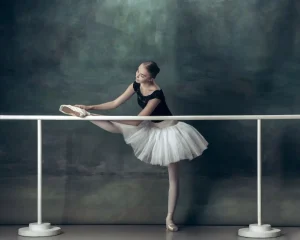
The barre is not a warm-up. It is not a preliminary activity to be rushed through before the real work of centre practice begins. The barre is where the foundational classical ballet techniques are developed, refined and maintained throughout a dancer’s entire career. The greatest dancers in the history of ballet, including Rudolf Nureyev, Mikhail Baryshnikov and Sylvie Guillem, maintained rigorous barre practices throughout their professional careers precisely because they understood that the barre is where technical quality is built and where it is preserved against the deterioration that performance demands impose on the body. A barre practiced with full physical and mental engagement is as demanding and as artistically rich as any other component of classical training.
Pliés, Tendus and Dégagés – The Holy Trinity of Barre Work
Pliés, tendus and dégagés are the first three exercises in virtually every classical barre sequence and they are not merely beginner exercises that advanced dancers leave behind. They are the foundational vocabulary upon which every other classical movement is built and their quality of execution in an advanced dancer directly reflects the quality of their overall technical foundation. The plié, literally meaning to bend, is the fundamental action of bending both knees simultaneously while maintaining turnout, alignment and the natural elevation of the heel in demi-plié, and with a fully stretched heel returning to the floor in grand plié.
Développés, Ronds de Jambe and Building Functional Strength
Développés and ronds de jambe represent a progression in barre complexity that develops the extended range of movement, the functional strength of hip flexion and the rotational quality of the working leg that the more demanding classical vocabulary requires. The développé, literally meaning developed or unfolded, involves passing the working foot through cou-de-pied and retiré positions before extending it to a fully raised and fully turned-out position in any direction. Its quality reveals the depth of the dancer’s hip flexibility, the strength of their standing leg stability and the control of their rotator musculature with extraordinary precision.
Centre Work and the Transfer of Barre Skills to Open Space
The transition from barre to centre is one of the most revealing moments in classical ballet training. At the barre, the supporting hand provides both physical assistance and psychological reassurance. In the centre, the dancer must generate all stability, balance and spatial orientation from within their own body without external reference. The technical challenges of barre work do not disappear in the centre. They intensify. Balance demands increase dramatically because the barre assistance that made sustained single-leg positions feel manageable is no longer available. The coordination demands of port de bras, épaulement and footwork performed simultaneously in the centre are considerably greater than the same elements practiced in the relative isolation of barre work. And the spatial awareness required to maintain consistent quality of alignment and technique while moving through open space and in relation to other dancers requires a level of proprioceptive sophistication that only develops through extended centre practice.
Jumps, Turns and the Technical Demands of Elevation
The classical jumping vocabulary represents one of the most demanding technical achievements in human movement and simultaneously one of the most visually spectacular. The physical prerequisites for quality classical jumping include powerful and coordinated pliés that generate and absorb the forces of takeoff and landing, fully articulated and controlled foot pointing through the full range of ankle and toe extension, the core stability and spinal alignment that allows the upper body to remain calm and expressive while the lower body generates explosive force and the rotator strength that maintains turnout through the full arc of elevation and descent.
Conclusion
The paradox of classical ballet technique is that its ultimate purpose is its own disappearance. The years of disciplined barre work, the patient repetition of foundational exercises, the careful development of alignment, turnout, musicality and artistry, all of this work exists in service of the moment on stage when none of it is visible. When the audience sees only the emotion, only the story, only the breathtaking beauty of a human body moving with apparent effortlessness through space and time. The techniques do not disappear in that moment. They become the invisible architecture of an experience that transcends technique entirely. Every dancer who commits to the foundational classical ballet techniques outlined in this guide is investing in that disappearance. In the hard-won freedom that only genuine mastery can provide. The barre is waiting. The work is beautiful.